The short answer: To write a memoir, pick one part of your life and the question it answers, rather than your whole life story. Gather your memories with timelines, photos and conversations, choose a structure, and write in scenes so readers live the moments with you. Then revise with honest feedback, handle the real people in your story fairly, and choose how you want to publish. Most memoirs land between about 65,000 and 90,000 words, but a shorter book written for family is just as valid.
Almost everyone who has lived a while has been told, “You should write a book.” Maybe you raised a family through hard years, built a business from nothing, served your country, survived an illness or simply watched the world change in ways your grandchildren can’t imagine. A memoir is how that experience outlives you.
The hard part is rarely the stories. It’s knowing where to start, what to leave out and how to turn memories into chapters people want to keep reading. This guide walks you through the whole process in ten steps, from finding your focus to publishing the finished book, with the questions authors ask us most along the way.
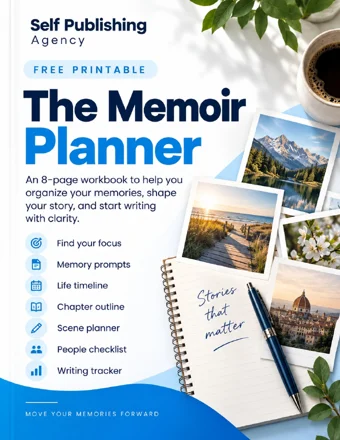
FREE PRINTABLE
The Memoir Planner
An 8-page workbook that follows this guide: find your focus, memory prompts, a life timeline, a chapter outline, a scene planner, a people checklist and a writing tracker. Print it and fill it in at your own pace.
Download the free PDF No sign-up needed · US Letter size, prints well in black and whiteWhat is a memoir (and how is it different from an autobiography)?
A memoir is a true story drawn from your own life, focused on a particular theme, period or experience. An autobiography tries to cover a whole life in order, usually from birth to the present. The difference matters, because it changes how you choose what goes in.
| Memoir | Autobiography | |
|---|---|---|
| Scope | One theme, period or turning point | Your whole life, start to finish |
| Order | Any order that serves the story | Usually chronological |
| Focus | What happened and what it meant | What happened, when |
| Feel | Personal, reflective, scene by scene | Broader, more like a record |
| Best for | Most first-time authors | People whose whole career is of public interest |
For most people, a memoir is the better choice. “The year I lost my business and found my faith” is a book readers can feel. “My life from 1958 to today” is harder to make compelling, even when every chapter is true.
Step 1: Decide what your memoir is really about
Before you write a single chapter, try to finish this sentence: “This is a book about how I…” For example:
- …learned to be a father after growing up without one.
- …rebuilt my life after thirty years in one career ended overnight.
- …cared for my mother through dementia and came out changed.
- …came to America with nothing and built a family business.
That sentence is your compass. When you’re unsure whether a story belongs, ask whether it moves that journey forward. A wonderful memory that doesn’t serve the theme can go in a family letter instead. Cutting it isn’t losing it.
Step 2: Know who you’re writing for, and why
Your reader shapes almost every decision, from how much background to explain to how private you can be.
- Family and future generations. You can include names, places and details that matter mostly to them. A small print run for relatives is a perfectly good goal.
- Readers who share your experience. Veterans, caregivers, immigrants, people in recovery or entrepreneurs want honesty and practical insight. Your story should offer them something to take away.
- Clients and your professional audience. A business memoir can build authority, but it still needs to be a story first and a brochure never.
Write your reason down as well. “I want my grandchildren to know where they come from” and “I want to help other caregivers feel less alone” lead to different books, and both are worth writing.
Step 3: Gather your memories before you start writing
Memory is patchy, and that’s normal. Spend a few weeks collecting raw material before you draft. It makes the writing faster and the details richer.
- Build a timeline. List the key years and events in order, even roughly. It keeps your facts straight later.
- Make lists. Houses you lived in, jobs you held, people who changed you, the worst day, the best day. Lists unlock memories that a blank page doesn’t.
- Go through photos, letters and documents. Old photos bring back sounds, smells and conversations. Letters, diaries, calendars and records also help you check dates.
- Talk to people who were there. Siblings, old friends and colleagues remember things you’ve forgotten, and sometimes remember them differently. Both are useful.
- Record yourself talking. Many people tell a story far better out loud than on paper. Use your phone to record memories, then transcribe them as a starting point.
Step 4: Choose a structure for your story
Structure is the order in which you reveal your story. There’s no single right answer, but choosing one early saves a lot of rewriting.
| Structure | How it works | Works well when |
|---|---|---|
| Chronological | Events in the order they happened | Your story has a clear beginning, middle and turning point |
| Thematic | Each chapter explores one theme, like home, work or faith | The lessons matter more than the timeline |
| Frame | Starts at a key moment, then goes back to explain how you got there | One dramatic event shaped everything |
| Braided | Two timelines alternate, such as past and present | Your present life mirrors or answers your past |
If you’re unsure, start chronological. It’s the easiest to draft, and an editor can help you rearrange chapters later if another structure suits the story better.
Step 5: Write in scenes, not summaries
This is the single biggest difference between a memoir people finish and one they put down. A summary tells the reader what happened. A scene lets them experience it.
Summary: “My father was strict, and we often argued about my future.”
Scene: “He set the college brochure on the kitchen table, squared its edges with two fingers and said, ‘Engineering. We’ve talked about this.’ I hadn’t said a word.”
Good scenes have a place, a moment, something the reader can see or hear, and usually some tension. You don’t need every chapter to be scene after scene. Use summary to move quickly through time, and slow down into scenes for the moments that matter most.
Dialogue is fine even if you can’t remember the exact words. Readers understand that memoir recreates conversations. The rule is to stay true to what was said and meant, and never invent things people didn’t say.
Step 6: Find your voice, then and now
Every memoir has two narrators: the younger you who lived the events, and the older you who understands what they meant. The best memoirs move between the two. Let the reader feel your confusion or fear in the moment, then step back now and then to reflect on what you know today.
Your voice is simply the way you talk when you’re telling a story to someone you trust. If your writing sounds stiff, read it out loud. Wherever you’d never say a sentence that way, rewrite it the way you would.
Step 7: Write the first draft (and let it be imperfect)
The goal of a first draft is to exist. Don’t polish chapter one for months. Get to the end, then improve it.
- Set a routine you can keep. Thirty minutes a day beats a whole weekend once a month.
- Write the easy chapters first. You don’t have to draft in order. Momentum matters more.
- Leave notes instead of stopping. If you can’t remember a date, write [CHECK DATE] and keep going.
- Aim for a sensible length. Published memoirs commonly run about 65,000 to 90,000 words. A family memoir can be much shorter. Our word count to page count calculator shows how many printed pages your draft will make.
Painful chapters can take longer, and that’s okay. Many authors find it easier to write the hardest scenes once they’ve built up some momentum with the rest of the book.
Step 8: Write about real people fairly and safely
Your story will include family, friends, former partners and colleagues. You have every right to tell your own story, but it helps to understand the two legal risks that come up most often in memoir. This is general information, not legal advice.
- Defamation. In general, this is a false statement presented as fact that damages someone’s reputation. Truth is a defense, which is why accuracy matters so much.
- Invasion of privacy. Publicly revealing private, embarrassing facts about a living person can create problems even when the facts are true, especially if they aren’t needed to tell your story.
Practical habits that lower your risk:
- Check facts against documents, records and other people’s memories. Where you can’t verify something, say it’s how you remember it.
- Write about how events affected you, rather than labeling other people’s character.
- Leave out private details that don’t serve the story. A useful test is to ask whether the detail is there to explain your journey or to settle a score.
- Change names and identifying details where a person isn’t central, but know this doesn’t remove all risk if readers can still tell who it is.
- For sensitive material, such as accusations of wrongdoing, have a publishing attorney review those passages before you publish.
Some authors also share relevant chapters with family members before publication. You don’t need their permission to tell your story, but a conversation now can prevent a lasting rift later.
Step 9: Revise, then get honest feedback
Put your finished draft away for a few weeks, then read it straight through. You’ll see repetition, slow stretches and places where the reader needs more context. Revise in layers:
- The big picture. Does every chapter serve your theme? Is the order right? Does the ending land?
- Scenes and pacing. Are the key moments shown as scenes? Does anything drag?
- Sentences. Clarity, rhythm and word choice come last.
Then ask two or three readers you trust, ideally people who read memoirs and aren’t in the book, to tell you where they were moved, confused or bored. After that, a professional editor makes the biggest difference. A developmental editor looks at structure and story; a copy editor and proofreader polish the language. You can read more about the stages on our book editing page.
Step 10: Decide how you’ll publish
Memoirs reach readers in three main ways:
- Traditional publishing. You find a literary agent, who pitches the book to publishers. It’s competitive for memoir, and publishers often look for an author with an existing audience or an unusual story.
- Self-publishing. You publish through platforms such as Amazon KDP, IngramSpark and Barnes & Noble Press, keep control of your book and earn royalties directly. Our guides on how to publish a book and self-publishing on Amazon walk you through it.
- A private edition. A small print run of beautiful hardcovers for family, without public sale.
Whichever route you choose, be careful with companies that charge large fees and promise bestseller status or guaranteed sales. Our guide to the warning signs of a self-publishing scam shows what to look out for.
Common memoir mistakes to avoid
- Trying to include everything. The best memoirs are selective. Depth beats coverage.
- Starting at birth. Open with a moment that pulls the reader in, then fill in the background.
- Telling instead of showing. Summaries keep readers at a distance. Scenes bring them close.
- Writing to get even. Readers can sense score-settling, and it weakens your credibility. Fairness makes your story stronger.
- Leaving out what changed. Readers want to know what you learned or how you’re different now. That reflection is what makes a memoir more than a list of events.
What if you’d rather not write it yourself?
Many people have a powerful story but not the time, energy or confidence to write 70,000 words. That’s what memoir ghostwriters are for. A ghostwriter interviews you over a series of conversations, gathers your stories and drafts the book in your voice, and you review and approve every chapter. The book is published under your name, and it remains your story.
If you’re weighing that route, our guide on how to hire a ghostwriter explains what to ask and what to watch for, and our memoir ghostwriting page shows how we work with authors. Either way, the steps above still apply: a great memoir starts with knowing what your story is really about.
Frequently asked questions
How long does it take to write a memoir?
It varies widely. Writing a little each day, many people finish a first draft in several months to a year, and revision takes longer. Gathering your memories first and keeping a steady routine are the two things that speed it up most.
How long should a memoir be?
Published memoirs commonly fall between about 65,000 and 90,000 words, and many run shorter. A memoir written mainly for family can be any length that tells the story well.
Do I need permission to write about my family?
Generally, you don’t need permission to tell your own true story. The risks come from false statements and unnecessary private details about living people. Stick to what you can support, leave out details that don’t serve the story, and consider a legal review for sensitive chapters. This is general information, not legal advice.
Can I change names in my memoir?
Yes, and many authors do, often with a short note at the front saying some names and details have been changed. It protects privacy, but it doesn’t remove legal risk if readers can still identify the person.
Can I write a memoir if I’m not a writer?
Yes. Your story and your honesty matter more than polished prose. Recording yourself telling stories, writing in scenes and working with an editor will take you a long way. If you’d rather not write it at all, a memoir ghostwriter can write it with you, in your voice.
Does everything in a memoir have to be true?
Readers expect a memoir to be true to your experience. Recreated dialogue and compressed timelines are widely accepted, but inventing events is not. If something is uncertain, say it’s how you remember it.
Should I self-publish my memoir or look for a publisher?
Traditional publishers are selective with memoirs and usually want an existing audience or an unusual story. Self-publishing lets you publish on your own schedule, keep control and earn royalties directly. For a family edition, self-publishing or a private print run is usually the simplest route.
Sources: Lisa Cooper Ellison, “How Can I Avoid Lawsuits When Writing Memoir?” (Jane Friedman); Amy Cook, “A Writer’s Guide to Defamation and Invasion of Privacy” (Writer’s Digest); Authors Alliance, Writing About Real People; Dana Isaacson, “Genre Book Length” (Career Authors).